http://en.wikipedia.org/wiki/Solar_cycle
http://www.nytimes.com/cwire/2011/06/09/09climatewire-this-weeks-solar-flare-illuminates-the-grids-63979.html?pagewanted=all
http://greekgeek.hubpages.com/hub/massive-solar-flare-1859
http://www.telegraph.co.uk/science/space/7819201/Nasa-warns-solar-flares-from-huge-space-storm-will-cause-devastation.html
http://science.howstuffworks.com/solar-flare-electronics.htm
Monday, September 23, 2013

Thursday, September 19, 2013
Starting Unit 3
Group Whiteboard questions:
- Scan through the first 12 slides. Then, discuss the statement "Why is sunlight responsible for life on earth?" List what evidence you have that supports the statement.
- Focus on the radius and mass of the Sun and compare it to our Earth and Jupiter.
- Finally, look at the differences in temperature between the core and the convection zone, and try to explain it to me using a meaningful analogy. (Example: the difference between a tornado and a breeze is like a semi of rice grains compared to a dozen).
We watched excerpts from:
Citation (MLA)
The Sun. National Geographic. 2004Learn360. 19 September 2012
http://www.learn360.com/ShowVideo.aspx?ID=128186
Citation (MLA)
Secrets Of The Sun. A&E Television Networks. 2007Learn360. 19 September 2012
http://www.learn360.com/ShowVideo.aspx?ID=227115
We took notes regarding:
The Sunspot Cycle
Maunder Diagram
Space Weather
Day 2
Go to the link below. Try looking at a spectra that is 350 degrees, 1000 degrees, and 6000 degrees. What amount of visible radiation is shown in each of those? Why do we have blackbody spectra for stars?
Link: Black Body Radiation
Complete the sun lab using the sheets provided, and the link shown below
Link: Sun Lab
Line Spectra Lab
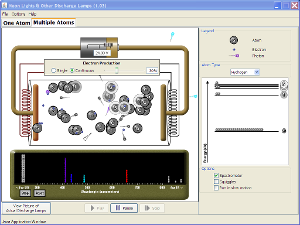
| Click to Run |
Investigate screen and experiment with the situations. Predict what will happen under the following situations:
What will happen when the voltage is increased?
With the voltage at a given amount, what will happen when the heater percentage is reduced?
If conditions are set so that light is being produced in multiple molecule mode, what will happen in single atom mode? Check your predictions.
Questions: 1. What condition(s) must be met in order for light to be produced by a discharge lamp?
2. What event(s) occurs to actually produce the light we see?
3. Does the spectrophotometer indicate unique spectrums for each gas?
4. What types of electromagnetic radiation are produced?
5. How could this phenomenon be used by astronomers?
Tuesday, September 17, 2013
The Heliosphere
We went over this
material on 9/17, when many students were gone for the UNI college fair.
http://en.wikipedia.org/wiki/Heliosphere
http://voyager.jpl.nasa.gov/mission/interstellar.html
You are responsible for this material on the test.
==============================
Moons of Jupiter Exercise: http://physics.highpoint.edu/~atitus/clea/moons-of-jupiter/
material on 9/17, when many students were gone for the UNI college fair.
http://en.wikipedia.org/wiki/Heliosphere
http://voyager.jpl.nasa.gov/mission/interstellar.html
You are responsible for this material on the test.
==============================
Moons of Jupiter Exercise: http://physics.highpoint.edu/~atitus/clea/moons-of-jupiter/
Monday, September 16, 2013
The Last Bits and Pieces
Today, you will be reading and summarizing. At the end, you may take a picture of your notebook writings or you may simply do all the summarizing in your online journal, but I will need to see your work. When you get done, you may work on your video.
READINGS on the Bits in the solar system.
READINGS on the Bits in the solar system.
How Far Have We Gone?
The Magnetosphere
Building a Moon
Asteroid Encounters
Space Junk
==========
Diameter of the Moon (at home lab for extra 10 points, due on 9/18)
============Pluto as Planet Discussion at YOUR TABLE============
The Magnetosphere
Building a Moon
Asteroid Encounters
Space Junk
==========
Diameter of the Moon (at home lab for extra 10 points, due on 9/18)
============Pluto as Planet Discussion at YOUR TABLE============
Come up with a 1 page summary as a group. Hand in.
Pluto isn't a planet
Pluto IS a planet
How was Pluto discovered?
Pluto isn't a planet
Pluto IS a planet
How was Pluto discovered?
Wednesday, September 11, 2013
Moon or Mars or Bust
You and your partner have a choice to make. Should the first off-Earth settlement be built on the Moon or on Mars?
There are pros and cons to each.
I. To start, let's look at the current information out there. Scan these two articles and provide a summary for each.
II. Then see some of the thoughts behind this dream by looking at the different thinking plans.
http://en.wikipedia.org/wiki /Colonization_of_Mars
http://marshome.org/
http://en.wikipedia.org/wiki/Colonization_of_the_Moon
http://www.nss.org/settlement/
The point of this is to figure out critical needs. Make a t-chart to list the differences between the Moon and Mars.
III. Now look at some of the missions that have already been put together to each planet:
http://planetary.org/explore/topics/the_moon/missions.html
http://mars.jpl.nasa.gov/programmissions/
What have they already figured out about the planet regarding the atmosphere or the availability of water?
IV. Use your Current Posters or other readings to help you see if there are:
a) plate tectonics
b) a magnetosphere
c) an atmosphere
d) water
e) gravitational forces
f) minerals
g) temperature extremes
How does this information affect your decision?
V. Use the solar system orrery to determine the distance between the Earth and the Moon and the Earth and Mars. How long do you think it will take to get there on a space mission, and what does that mean for a launch date?
VI. Finally, take a look at the life and health risks involved in being an astronaut on a long-term journey.
Based on these health risks, do you want to be the one to travel on your journey? And whether you do or not, what are 10 things needed for the journey keep your brain and emotions healthy? Explain.
Where should we go? Make your decision, and be prepared to support it with at least 5 reasonable arguments/evidence. Create a video blog, or a powerpoint, or a podcast interview(share it with me) or email it to me. This is due by Sunday night at 11:59 pm
Rubric for grading--Individual
Boldface questions are worth 30 points and must be done individually in your shared Google Docs Journal. I expect either complete sentences or bulleted points.
Rubric for grading--Group
This presentation is worth 60 points
| Category | Excellent | Acceptable | Marginal | Unacceptable |
| Quality of Product Multimedia | Worthy of the World | Informative and Loved By Parents | Entertaining to Friends | Rude, or Socially Unacceptable |
| Quality of Content | Worthy of the World | Informative and Loved By Parents | Entertaining to Friends | Rude, or Socially Unacceptable |
| Persuasiveness to a Position | Worthy of a Debate Scholarship | Gets a II at Individual Speech | Snowjob | Rude, or Socially Unacceptable |
| Identification of the Risks Involved | Worthy of a NASA or insurance report | Acceptable to someone who is on Survivor | Adequate for those who shun safety gear | Rude, or Unacceptable |
| Thoroughness of Information | Worthy of a private boardroom presentation | Filled with Geeky Speak | Entertaining to Friends | Rude, or Socially Unacceptable |
Tuesday, September 10, 2013
Project Poster for Two
There is poster paper in the front of the room underneath the black table that does NOT have a microwave on it. Use that, and colored pencils to complete this activity. TEAMS OF TWO, or do it individually.
Remember, posters are VISUAL devices. I want pictures, not just factoids, ok, so do not number 1-5. And do not do the same thing as your classmate, please?
1. Compare our moon to one of the moons of Juipter in terms of plate tectonics, surface temp range, water, atmosphere, and composition.
2. Compare the Earth to Mars in terms of plate tectonics/volcanoes, water, atmosphere, surface temp range, and composition
3. Compare Earth to a gas giant using five features of your choosing.
4. Explain the importance of a magnetic field, and determine which moons or planets likely have them.
5. What features of the Earth makes life on it more possible than any other planet? Explain your reasoning.
The powerpoint will help. So will your notes from Friday. You may save a copy to your Google Docs, or just use the published version below.
Remember, posters are VISUAL devices. I want pictures, not just factoids, ok, so do not number 1-5. And do not do the same thing as your classmate, please?
1. Compare our moon to one of the moons of Juipter in terms of plate tectonics, surface temp range, water, atmosphere, and composition.
2. Compare the Earth to Mars in terms of plate tectonics/volcanoes, water, atmosphere, surface temp range, and composition
3. Compare Earth to a gas giant using five features of your choosing.
4. Explain the importance of a magnetic field, and determine which moons or planets likely have them.
5. What features of the Earth makes life on it more possible than any other planet? Explain your reasoning.
The powerpoint will help. So will your notes from Friday. You may save a copy to your Google Docs, or just use the published version below.
Thursday, September 5, 2013
Scales of the Solar System
http://en.wikipedia.org/wiki/Orrery
http://www.solarsystemscope.com/

QUESTIONS TO ANSWER
Today, in addition to looking at the issue of Retrograde Motion, we also need to consider the issue of how big the solar system is. We really don't understand that too well. You need to take the time to look at the following links, and then answer the questions below.
Scaling the Solar System
Retrograde Motion
Parallax
QUESTIONS TO ANSWER
Today, in addition to looking at the issue of Retrograde Motion, we also need to consider the issue of how big the solar system is. We really don't understand that too well. You need to take the time to look at the following links, and then answer the questions below.
Scaling the Solar System
Retrograde Motion
Parallax
Subscribe to:
Posts (Atom)